
Google’s Willow quantum processor demonstrates quantum contextuality at 105-qubit scale
Google Quantum AI reported in Science that its 105-qubit superconducting Willow processor won a quantum contextuality game 98.30 percent of the time, exceeding the classical limit of 88.89 percent. The team also measured a contextuality indicator of 5.590 against a classical ceiling of 4 and a quantum maximum of 6, verified entanglement across 45 qubits, and ran a hidden linear function algorithm on up to 105 qubits with success probability above 50 percent.
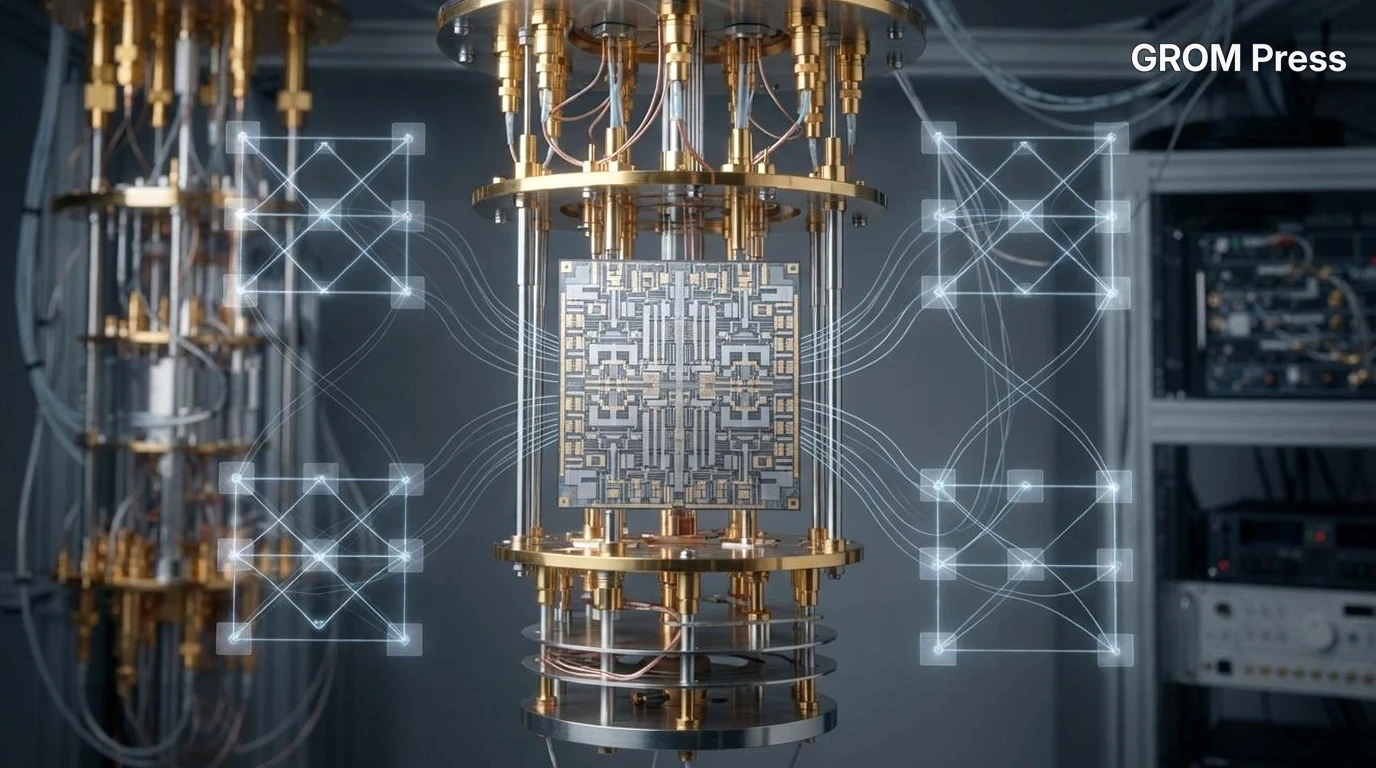
Google Quantum AI has published results in Science showing that its 105-qubit superconducting processor Willow exhibits quantum contextuality at scale. Contextuality is a property of quantum systems in which the outcome of a measurement depends on which other compatible measurements are performed at the same time. The researchers say this property may be one of the physical resources behind the advantage of quantum algorithms over classical computation.
To test the property, the team used a magic square game. In this game, two participants must fill a row and a column of a 3 by 3 grid with plus one or minus one without communicating. They win if their entries match in the intersecting cell. Any pre-agreed classical table can win at most 8 out of 9 rounds, or 88.89 percent. Google played all nine versions of the game 100,000 times each and reported a win rate of 98.30 percent plus or minus 0.01 percent. That means the processor lost roughly one game in 60, while any classical strategy must lose at least one in nine.
The team also measured contextuality directly using the Bell-Kochen-Specker inequality. For classical systems, the indicator chi cannot exceed 4, while quantum mechanics allows up to 6. Google obtained chi equal to 5.590 plus or minus 0.008, which is clearly above the classical boundary and about 7 percent below the quantum limit. The company noted that the test is independent of the initial qubit state, so the result characterizes the processor itself rather than a specially prepared dataset.
In a separate experiment based on the GHZ game, which relies on a special entangled state, the test covered up to 71 participants, each corresponding to one qubit. Quantum mechanics permits a win every time, while the best classical strategies give 75 percent for three participants and approach 50 percent as their number grows. Google did not reach the ideal result because of hardware noise, but the quantum system stayed above the classical boundary at all tested sizes. The team also confirmed genuine entanglement among 45 qubits.
Another experiment implemented a hidden linear function algorithm, for which a quantum advantage with constant-depth circuits was theoretically proven in 2018. Constant depth means the number of sequential computational steps does not grow with the task size. Google said it was the first implementation of such an algorithm on real hardware at large scale. The processor solved tasks on lattices of up to 105 qubits with a success probability above 50 percent.
The researchers added that contextuality tasks require coordinated operation of many qubits and can reveal subtle systematic errors that standard tests with random quantum circuits might miss. Physical limits serve as benchmarks: chi equals 6 for contextuality measurement and 100 percent for win probability. The company suggested this approach could help assess processor accuracy when running complex algorithms, including molecular simulation for chemistry and materials science.



Comments
No replies yet. Start the discussion.
Sign in to reply