
Euclid finds most distant known quasar, existing 630 million years after the Big Bang
The European Space Agency's Euclid space telescope has discovered the most distant quasar known to date, J1504+6252, named Dún Aonghasa. It existed 630 million years after the Big Bang at a redshift of 8.13. Follow-up observations with the Keck Observatory, the Large Binocular Telescope, the Hubble Space Telescope and the James Webb Space Telescope confirmed its nature and estimated the central black hole at about 360 million solar masses. The object challenges current models of early supermassive black hole growth because it is accreting relatively slowly despite its large mass.
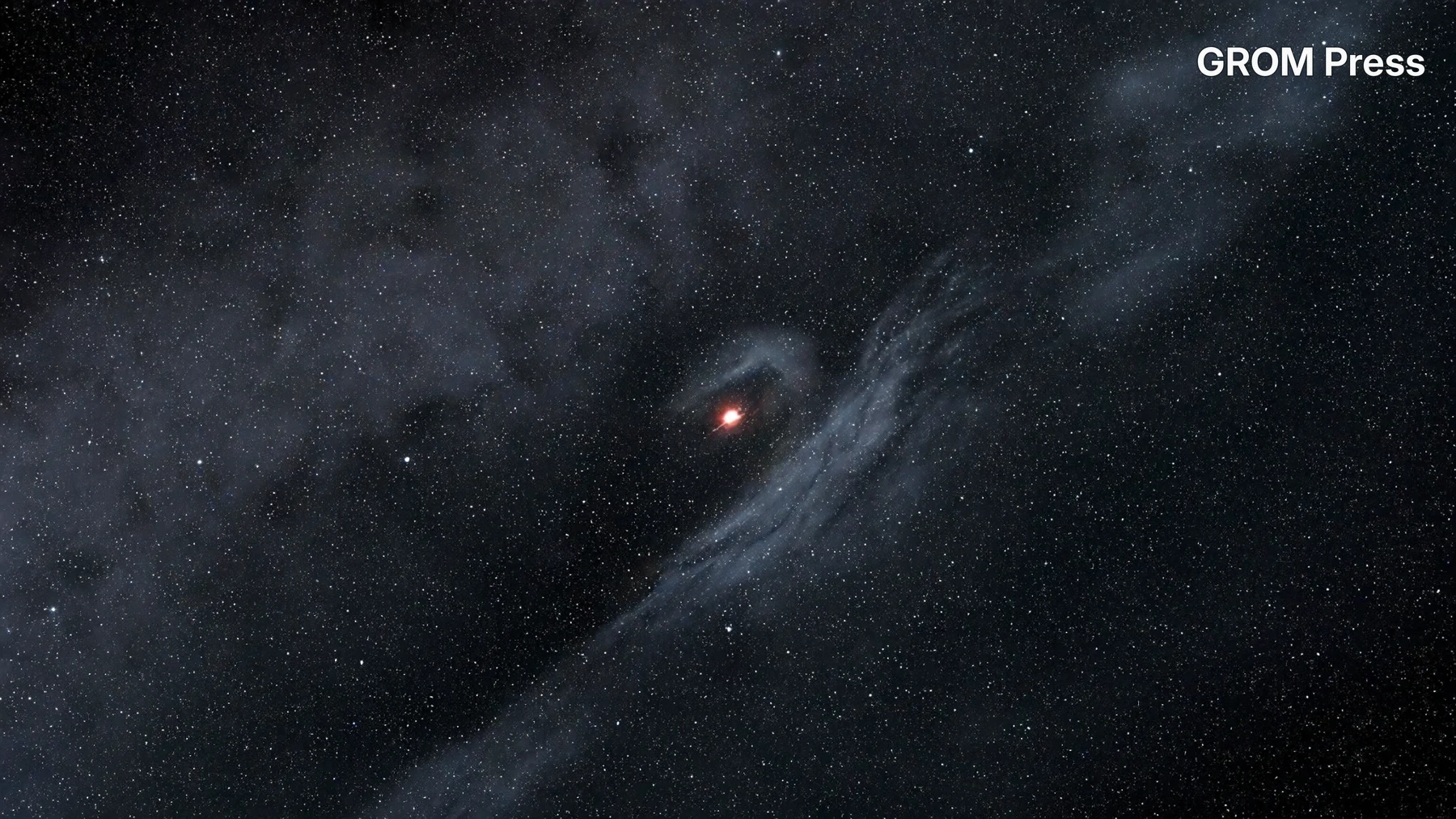
The European Space Agency's Euclid space telescope has discovered the most distant quasar known to date, J1504+6252, named Dún Aonghasa. The object existed 630 million years after the Big Bang and was observed at a redshift of 8.13, pushing the previous observational boundary back by about 40 million years. The previous record was also set by Euclid.
Euclid identified the quasar during analysis of roughly 18 months of observations among millions of registered objects. Its nature was subsequently confirmed using the Keck Observatory, the Large Binocular Telescope, the Hubble Space Telescope and the James Webb Space Telescope. The James Webb Space Telescope enabled an estimate of the central black hole's mass at about 360 million solar masses.
Quasars are extremely bright galactic nuclei whose glow is produced by gas heating up as it falls onto a supermassive black hole. Dún Aonghasa is unusual because, despite the black hole's large mass, it was accreting surrounding matter relatively slowly at the time the light was recorded. The observed accretion rate therefore does not explain how the object reached such a mass within the first 630 million years of the Universe's existence. It evidently underwent phases of exceptionally rapid growth in the past. The specific mechanism behind the formation of the first supermassive black holes remains a subject of research, and the data are relevant for testing theoretical models.
The discovery was made possible by Euclid's sensitive infrared imaging and wide sky coverage. The telescope was launched in 2023. In the first one and a half years of scientific operations, the mission identified 31 ancient quasars, including 12 objects with a redshift above seven. Previous surveys took about 15 years to detect a comparable number of quasars at such distances. Objects with a redshift above eight are so rare that only a few dozen such sources are expected across Euclid's entire planned survey area. J1504+6252 is the first of them.
The image accompanying the report shows the sought-after quasar as a red dot in the centre. The image source is ESA. A separate illustrative image was generated by AI using ChatGPT and published by 3DNews.



Comments
No replies yet. Start the discussion.
Sign in to reply