
Heavy higgsino dark matter could explain LUX-ZEPLIN signal and remain compatible with IceCube
Physicists have proposed an extended dark matter model based on higgsinos, hypothetical supersymmetric particles linked to the Higgs boson. The model can explain a rare high-energy xenon nucleus recoil of 248 keV recorded by the LUX-ZEPLIN experiment while remaining consistent with IceCube limits, which found no expected neutrinos from possible dark matter annihilation inside the Sun. Suitable model variants suggest particle masses from about 2 TeV to hundreds of TeV, with a mass difference between two neutral higgsino states of roughly 350-525 keV.
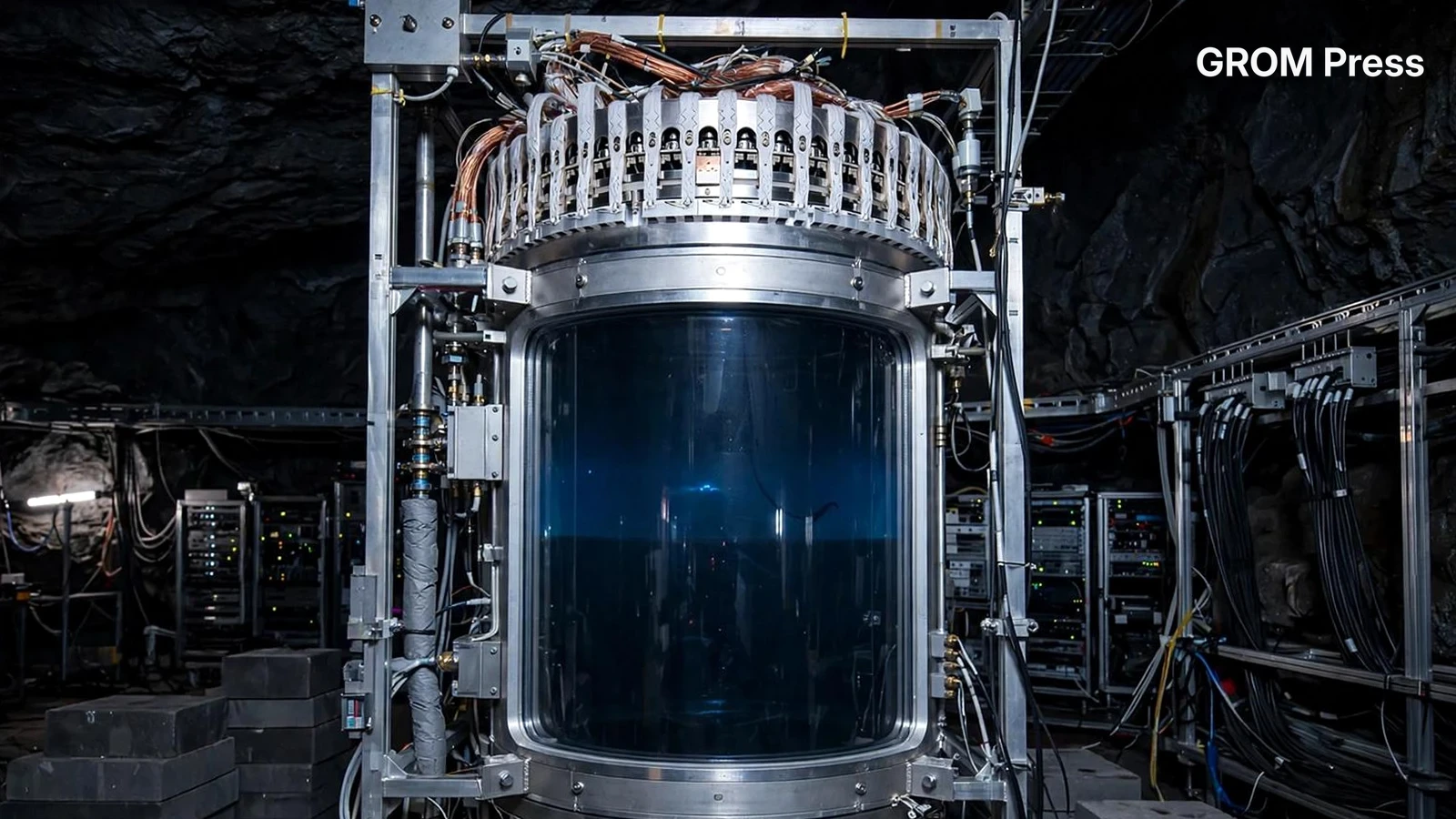
Physicists have proposed an extended dark matter model in which dark matter may consist of higgsinos, hypothetical particles associated with the Higgs boson in supersymmetry theories. The model is intended to explain an unusual event recorded by the LUX-ZEPLIN experiment: a xenon nucleus recoil with an energy of 248 keV. The authors checked their calculations not only against LZ data but also against constraints from the IceCube observatory, where no expected neutrinos from possible dark matter annihilation inside the Sun were detected.
In the higgsino model, dark matter is represented by two neutral states with a small mass difference. When colliding with a xenon nucleus, the lighter particle can transition to the heavier state, transferring significant energy to the nucleus. According to the authors, this mechanism can produce a rare high-energy recoil similar to the LZ event. Their calculations indicate that suitable model variants have a mass difference of approximately 350-525 keV.
The result depends on the higgsino mass and the assumed dark matter velocity distribution near the Solar System. In particular, the authors accounted for the influence of the Large Magellanic Cloud, whose gravity may increase the proportion of especially fast particles near the Milky Way. This is important for the model because collisions with xenon nuclei capable of exciting the heavier higgsino state require high particle velocity.
The lightest option - a higgsino with a mass of about 1.1 TeV, which could have formed in the early Universe in an amount corresponding to the observed dark matter density - turned out to be only on the edge of compatibility with LZ and IceCube data. Heavier variants appear more convincing: under certain assumptions, the calculations allow masses from about 2 TeV to hundreds of TeV and above. For example, a variant with a mass of about 2 TeV remains compatible with both experiments when accounting for the influence of the Large Magellanic Cloud and without an additional restriction based on the absence of events in the higher-energy range of LZ.
However, this does not mean a reliable discovery of dark matter particles. The authors themselves emphasize that the conclusions depend on parameters that are not yet measured precisely enough: the particle velocity distribution, their interactions with matter inside the Sun, and the efficiency of cooling after capture by solar gravity. There is also experimental uncertainty: LZ has not yet published calibration of nuclear recoil detection efficiency in the additional high-energy range. In addition, IceCube constraints for masses above 10 TeV have to be evaluated by extrapolation in the study.
The model can be tested by new data on high-energy nuclear recoils, more accurate calculations of particle capture by the Sun, and independent searches for dark matter traces.



Comments
No replies yet. Start the discussion.
Sign in to reply