
IceCube registers high-energy neutrino candidate IceCube-261123A with moderate probability of astrophysical origin
The IceCube neutrino observatory at the South Pole detected a high-energy track-like event, IceCube-261123A, on 23 November 2026 at 06:54:16.99 UTC. The collaboration classified it as a candidate with moderate probability of astrophysical origin, meaning its cosmic source is not yet confirmed. The signal passed through the ICECUBE_Astrotrack_BRONZE alert stream, for which the estimated rate of false alarms from atmospheric background is 1.205 events per year. After refined reconstruction, the best-fit coordinates were right ascension 320.45 degrees and declination +24.58 degrees, with a 90-percent probability region of about 1.5 to 1.7 degrees in each coordinate.
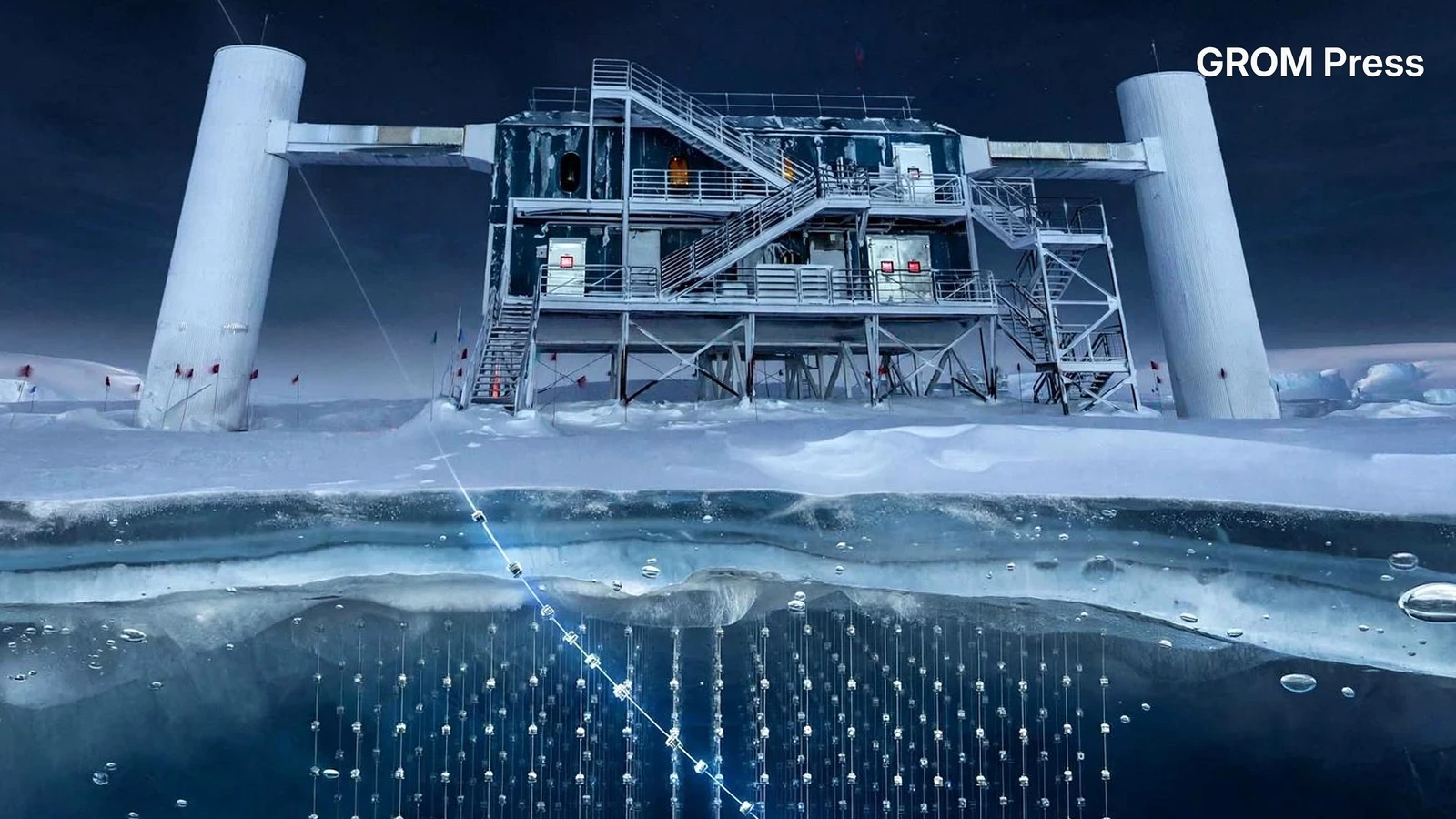
The IceCube neutrino observatory at the geographic South Pole registered a high-energy event designated IceCube-261123A on 23 November 2026 at 06:54:16.99 UTC, according to the IceCube collaboration. The signal was track-like, meaning it produced a characteristic sequence of detector hits that allows scientists to estimate the direction of the particle’s travel.
IceCube classified IceCube-261123A as a candidate with moderate probability of astrophysical origin. The collaboration said this means the signal may be connected to a cosmic source, but its nature has not been confirmed.
The event passed selection in the ICECUBE_Astrotrack_BRONZE alert stream. For this class of alerts, the estimated rate of false alarms caused by atmospheric background is 1.205 events per year. IceCube explained that such signals can arise not from neutrinos from distant astrophysical objects, but from interactions of cosmic rays with Earth’s atmosphere. Therefore, the registration of a candidate by itself does not prove an extraterrestrial origin.
After the initial automatic alert, specialists applied more advanced reconstruction algorithms and refined the incoming direction of the neutrino. The best-fit coordinates were right ascension 320.45 degrees and declination +24.58 degrees. The region containing 90 percent of the estimated probability of the true direction has an uncertainty of approximately 1.5 to 1.7 degrees in each coordinate.
No known gamma-ray sources from the Fermi LAT FL16Y catalogue, which covers 16 years of observations by the Fermi gamma-ray space telescope, were found in that region. IceCube said this does not exclude the existence of a neutrino source, because its emission may be faint, variable, or not accompanied by a detectable gamma-ray signal.
IceCube is a neutrino observatory of about one cubic kilometre located deep in the Antarctic ice at the geographic South Pole. It detects rare interactions of neutrinos with matter. When a collision occurs, secondary charged particles move through the ice and leave characteristic light, by which the detector reconstructs the direction and energy of the original neutrino.
The new signal remains a candidate for an astrophysical neutrino. Its coordinates and probability map were published in the Gamma-ray Coordinates Network system so that other observatories can check whether any unusual events were observed in that direction.


Comments
No replies yet. Start the discussion.
Sign in to reply