
Study of 136 galaxies finds dark matter deficit that cosmological models cannot explain
Observations of 136 nearby galaxies show that the most massive systems contain about 40-50 percent dark matter within 20,000 parsecs of the centre, while cosmological models predict around 70 percent. The deficit grows with galaxy mass and extends to 50,000 parsecs in the largest systems. Simulations TNG100, EAGLE, SIMBA and SIDM1 fail to reproduce the observations, and the authors have not identified the physical mechanism responsible.
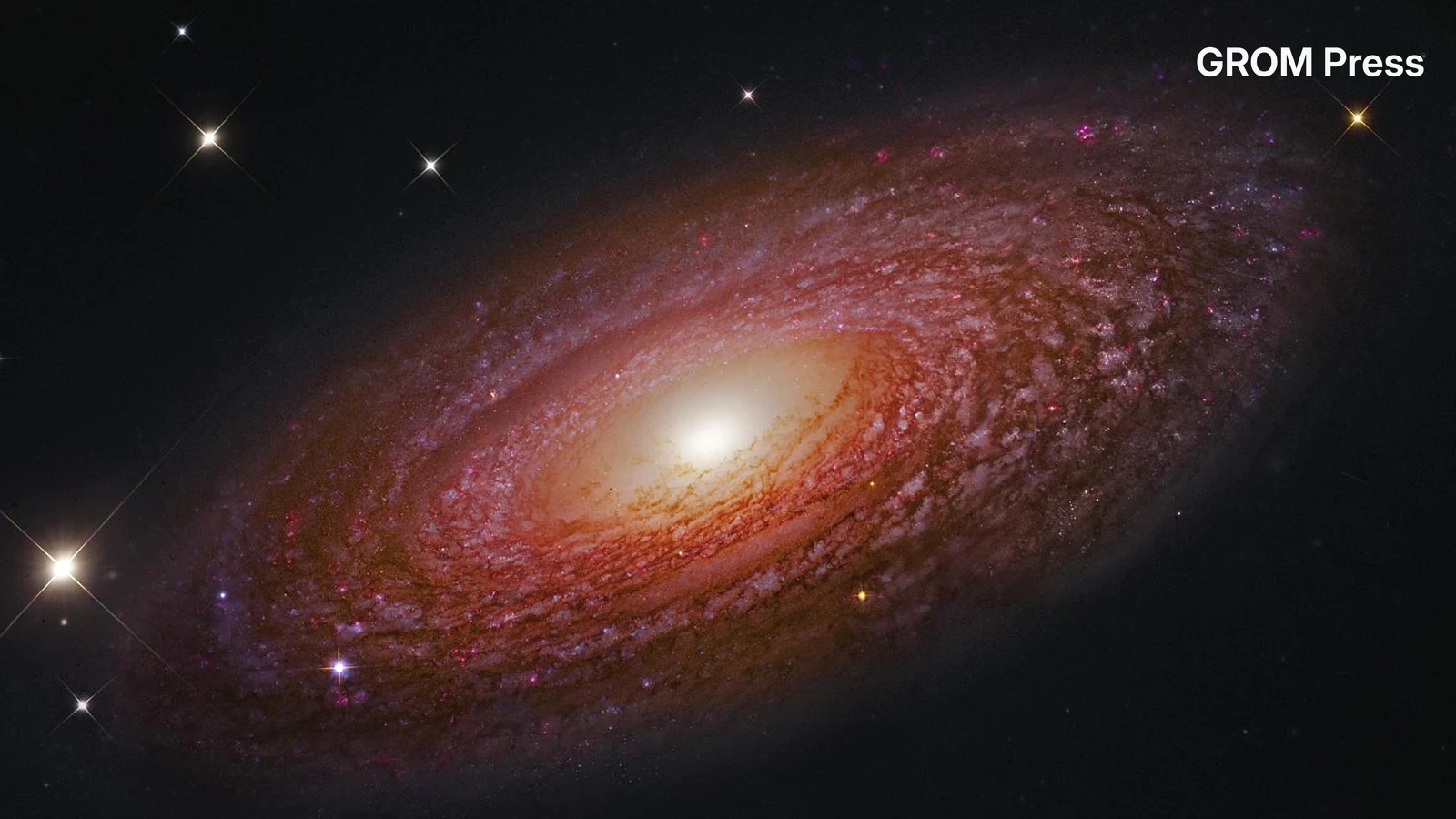
A study of 136 nearby galaxies has found a persistent deficit of dark matter in their central regions that current cosmological models do not explain, according to the research material.
The researchers divided the galaxies by mass and compared the observed distribution of dark matter with predictions from cosmological simulations. In the most massive systems, with stellar masses above 30 billion solar masses, dark matter accounted for about 40-50 percent of the mass within 20,000 parsecs of the centre. The models predict roughly 70 percent for such galaxies.
The discrepancy was widespread. Among the most massive galaxies, 90 percent had a dark matter fraction below the median model prediction, and 84 percent fell below even the level covered by the lowest sixth of simulated galaxies. This means most observed systems are not merely below average but outside the usual spread of the simulations.
The deficit becomes more pronounced as galaxy mass increases. For galaxies with stellar masses around 10 billion solar masses, the shortfall relative to calculations extends about 10,000 parsecs from the centre. In more massive galaxies it reaches 20,000-30,000 parsecs, and in the largest systems the low density persists across the entire studied region, up to 50,000 parsecs, equivalent to about 163,000 light years from edge to edge.
The result challenges common galaxy formation models. In simulations, interactions between ordinary matter and dark matter often cause the latter to concentrate closer to the centre of a massive galaxy. The observations show the opposite pattern systematically in massive galaxies. Several tested models could not reproduce the observed picture. Simulations TNG100, EAGLE and SIMBA all give a higher central dark matter fraction. Even the SIDM1 model, in which dark matter can interact with itself and form a less dense galactic core, does not explain the full magnitude of the discrepancy.
The team validated its method on 58 simulated galaxies. The checks showed the method recovers the mass distribution well enough from the available models, so the discrepancy cannot be explained by modelling errors or differences between the observed sample and simulated galaxies.
The authors have not established what physical mechanism creates these low-density dark matter regions. They emphasized that this is not a disappearance of dark matter or a refutation of the concept itself: at larger distances its density may be comparable to other galaxies of the same mass.
One possible explanation under consideration is feedback from active galactic nuclei. Supermassive black holes may expel gas from central regions, causing the dark matter distribution to expand and its density to fall. However, the available data do not allow researchers to identify the exact physical process responsible.
The results provide new observational benchmarks for testing galaxy formation models and the nature of dark matter. The next stage involves expanding samples and more precise radio observations, including within the WALLABY, MeerKAT and future SKA radio telescope projects.


Comments
No replies yet. Start the discussion.
Sign in to reply